Research / Education
The Hand + Technology
With the rise of technology and automation, how do we ensure that we continue to instill our human perspective in all that we make? Over the course of two days, students and faculty at Bowling Green State University were led through interactive exercises that included the heart, intuition, and technology.
An invitation to play with tech.
The process
By hand
Compose
In words
ArticulateSpecify
With the machine
InstructIterateCollaborate
I was asked by Bowling Green State University to take part in their Liminal Space Residency, as a guest workshop lead and speaker, and to share my experience working with emerging technologies and my process building tools.
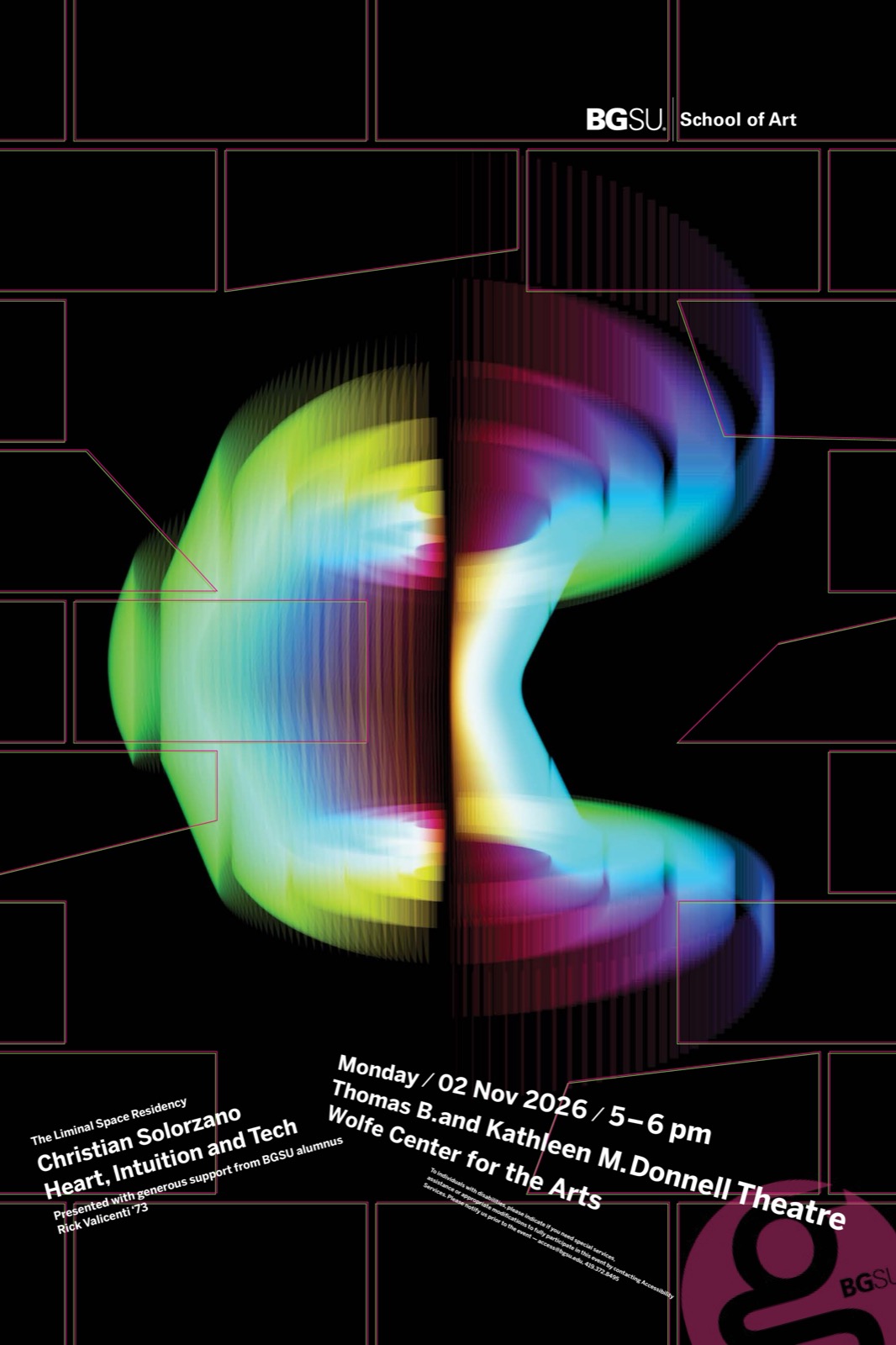
Leading up to the talks, skepticism from the university took shape in the form of comments posted on Instagram about the effects of AI on creativity and on jobs — all of which I addressed in our time together. Like most technologies of various time periods, communication and design coincide with what is of that moment. And the spirit of my time at BGSU was to express the importance of our analog perspective and point of view not being replaced by digital technology, which appears to be the concern of many.
By hand
The first part of the assignment was to create using our hands. With construction paper, students were asked to cut random shapes in different colors and make four compositions on eleven-by-seventeen sheets. The instructions were to go into the assignment with no agenda — rather, to be fully present and improvisational. The intention was to begin training the mind to be deliberate about the course of actions, meaning the order of operations. As students were manually completing their assignment, they were making mental notes of every action — the condition of the shapes, the color, the speed.
After the cutting, they transitioned to writing four poems, each of five lines, in ink on paper. I mentioned to the participants that they had no need to explain their poems afterwards, and that their writing could be as abstract or as literal as desired.
Then they wrote their poems onto the composition, being deliberate about the placement and the relationship with the shapes.
After this we debriefed, and spoke about the feelings that surfaced during the assignment. Most students are used to coming to an assignment with an end goal in mind, or a reason behind every action. Here the constraints were important to the output. Shapes. Paper. Ink. Time limit. And no sense of what was going to come next.
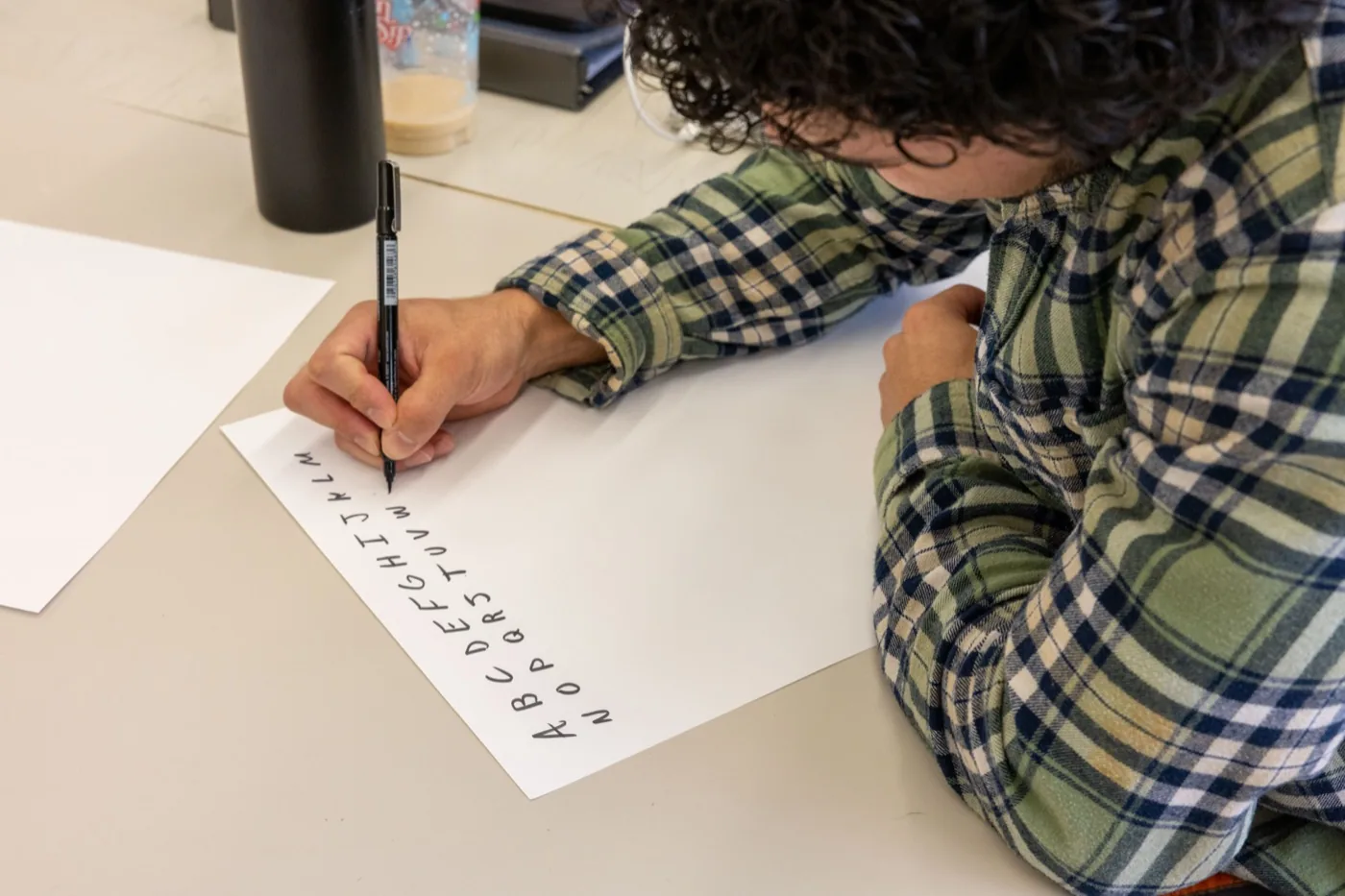
They were then asked to write uppercase and lowercase letters on paper, photograph them, and take them into Claude to turn them into a working .OTF — meaning they would now be able to type in their own handwriting. It strengthens the argument that you can bring yourself into your work regardless of the application. In previous times, this perhaps was not possible in such a short amount of time. So personalization now has become more feasible and iterative. Some students spoke about how the letters didn’t look like their handwriting, so I encouraged them to write down variations of each letter of concern, to allow AI to average the strokes and the subtleties, and then to be the final judge. I mentioned to them the importance of discernment and positioning.
The Machine
Instructions were carefully considered on paper prior to typing into computer.
- One canvas at eleven by seventeen
- Five shapes per canvas
- Five colors
- Colors never repeat
- Five lines of poetry
- The positioning of the text organic
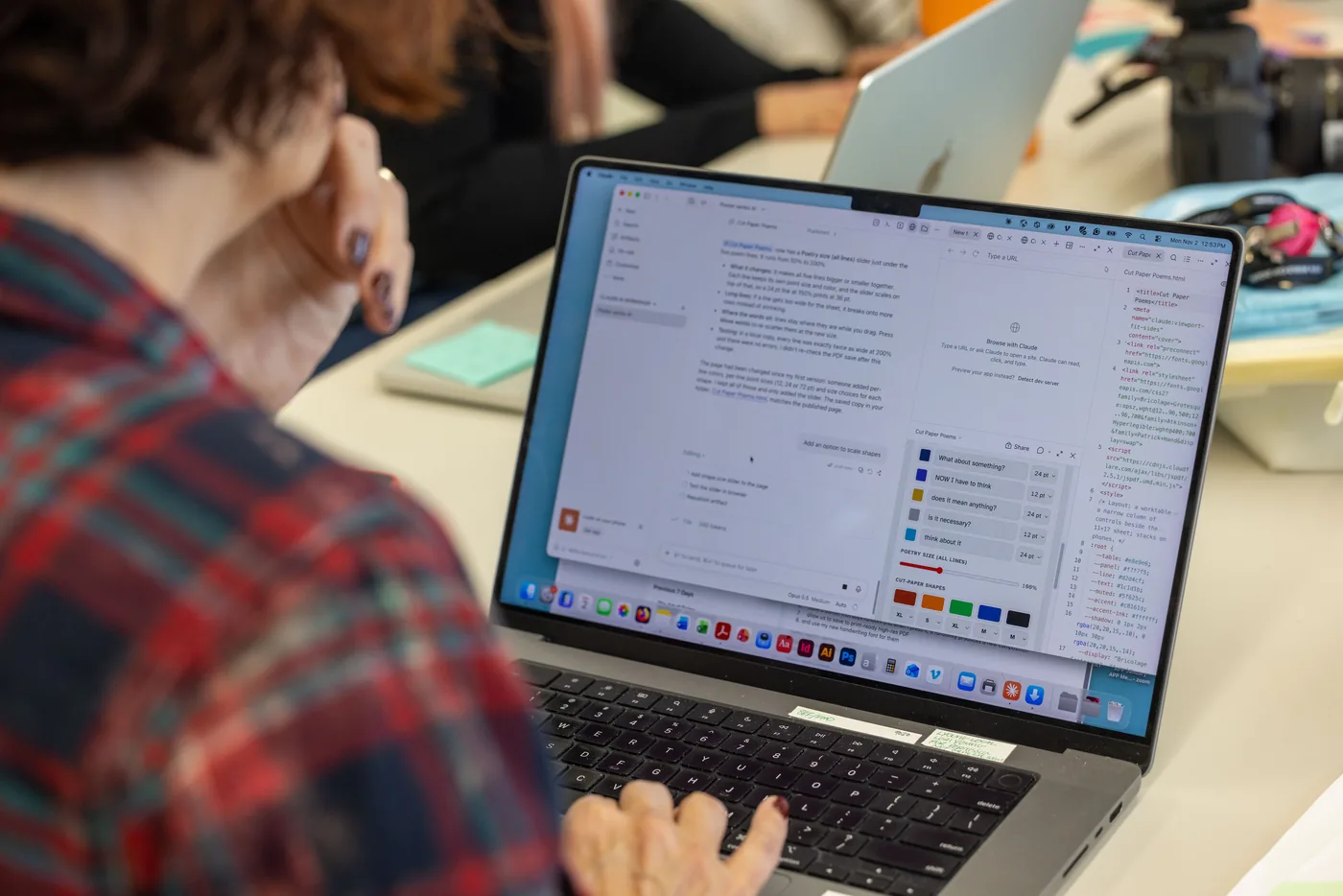
What I did not expect is that the same instructions made different tools. One person’s interface arrived with an uninvited drop shadow and shapes you could drag; another’s had checkboxes and numerous controllers; a third found her whole interface set in her own handwriting. “I used the same words that he put in his, and mine looks closer to yours than his.”
By the second morning the vocabulary was the subject. I think of working this way as an exercise in art direction, and as students you don’t really get an opportunity to direct — you are usually the one being directed. The difficulty they named was not the machine. It was the sentence: “I know what I want, but I don’t know how to say it.” One of them put the whole two days in a line — “it turns out writing the prompt is more difficult than actually making it.”
The objection in the room was never technical. It was about who is paid. Anthropic’s valuation, copyright, the photographs a colleague’s students make that are aggregated, etc. “Where’s the optimism? That’s what I’m looking for.” And underneath it, the question a teacher is obliged to ask: all these hours, how does that translate into a livable income? What I offered back was a change of position rather than a defense of the tool. Companies were hiring when I graduated and the brief was: let’s see you make a poster. It isn’t that any more. Let’s see you make a tool that makes posters — and explain your systems thinking and your method of direction.
On the second day, each student was asked the night before to come up with a distinct “imagine if” statement, in which they visualize a program they’d like to see — a tool that makes typography respond to sound, say, or the ability to design with your webcam. All of these experiences currently exist and are enabled by other programs like Cavalry or TouchDesigner, but today the learning curve is less steep, because all that is required is clear direction.
Participants were asked to make prints of their first assignment, and we used these machine-generated artifacts as a catalyst to assess the nature of our discernment and our direction. We spoke about what we liked and didn’t like, and what worked well versus what didn’t. In every instance I emphasized the importance of meticulous attention to detail, and of continuous iteration that refuses to settle for the default — although sometimes the Machine does surprise us.
intuition heart doubt passion obsession fear heartbreak desire longing excitement ecstasy solitude loneliness play wrong turns curiosity wonder grief patience failure risk joy silence accident memory love restlessness surrender faith chance vulnerability rage tenderness boredom awe
The storm of chaos
As part of our assignment, what was emphasized was the necessity of oscillating between the thinking and the doing — and not getting stuck in either domain. Rather, embrace both the intellect and non-knowing — and plunge into the emotions that arise from opening up to both of them. This is OP/AL’s essence.
How the tool was made, stage by stage.
-
Cutting shapes by hand
Twenty shapes cut out of colored paper and then composed on an 11 × 17 sheet of paper. The lesson is to obtain familiarity with material and form, and to slow down and experience embodiment.
-
the river keeps its own slow timepaper birds fold into the windwe cut the sky into small piecesand every blue was a different songhold the light. let it go.
Writing poems
Five lines of poetry written by hand and then placed alongside shapes within the composition. The lesson is to see the relationship between handwriting and hand-cut shapes.
-
abcdefghijklmnopqrstuvwxyz
Making a handwritten font
Rather than defaulting to software fonts, the alphabet was drawn by hand and then digitized and turned into a working font — thus teaching that agency and the hand can find their way into prompting.
-
Instructing the AI
We documented every step along the analog process and translated our steps into instructions that would allow our approach to be controlled via a program we created — and then we added more features.
The designer’s evolution
As designers, our practice continues to become democratized and our roles shift from production artist/designer — to a larger seat at a larger table, now our roles extend to various multidisciplinary and comprehensive roles and responsibilities.
Our findings.
- The order is the method1Nobody opened a computer until the shapes were cut and poems were written. Now, that we completed the analog, we proceeded to using the computer to train AI on our process and way of doing something. Identical rules produced unpredictable visual effects and controllers. One student said: “I used the same words that he put in his, and mine looks closer to yours than his.”
- The prompt is the assignment2The students’ own verdict, unprompted: “it turns out writing the prompt is more difficult than actually making it. You don’t really know what things I need to add every single time, so you try a lot of mistakes before you finalize your instructions.” What helped was writing the rules on paper first and, if possible, practicing dictating out loud, as this may make your direction feel more casual and natural to your speaking.
- A tool needs a shell3“Every time I was creating a tool, it was always reimagining the canvas from scratch, and it just got really annoying, because it was almost like I had to relearn how I was making things every single time.” The fix was a design system for the instruments that contains a familiar interface that establishes a language of operation and patterns.
- Agency converted the sceptics4The faculty who arrived saying “we don’t trust this tool” did not change their minds because of anything the software did. “By the end they were all bought in because they saw that they can use it while still maintaining their own agency and sense of self.”
Thinking in systems
As design and communication continue to evolve, the role of our practice is to consider the application of our work and how it exists within a larger system. This encourages designers to expand upon their ideas.
A conversation with a Zen Master
Weekly, I meet with my teacher Robert Joshin Althouse, a Zen Master, for koan study, which I’ve been practicing for four years. We go through a variety of Zen teachings each centered on activating the non-thinking thinking mind, and on this day, prior to him leaving for a conference in Berkeley on Buddhism — serendipitously, we spoke about AI and its implications on our humanity.
The koan I presented was from the book The Record of Transmitting the Light — and it reads:
The Fourth Ancestor, Venerable Upagupta, managed affairs for Venerable Śānavāsin for three years before finally shaving his head and becoming a bhiksu. The Venerable [Śānavāsin] asked him, “Does your body go forth from household life, or does your mind go forth from household life?” The Master [Upagupta] said, “Truly, it is the body that goes forth from household life.” The Venerable [Śānavāsin] said, “How could the sublime dharma of the buddhas be contingent on body or mind?” The Master thereupon greatly awakened.
And the explanation provided by Althouse is that “it’s not that body and mind are the problem, it’s that we’ve isolated body and mind as something apart from everything else.” We objectify the world, make a duality of it, and suffer the duality.
Then the koan turned. “If we give over our agency to agents, we’re losing our humanity. And we must not do that.” He was careful about what he was and was not saying: “I’m not objecting to AI. I’m just objecting to the speed in which we’re going down this path with very little thought about what we’re actually doing.” Our practice, he said, implies lawfulness — “if we’re on a spiritual path, we’re on a path of governing that’s about governing ourselves.”
He draws the line at suffering. “The most useful definition of consciousness is the ability to suffer. If something has the ability to suffer, then it’s conscious. And that has an ethical implication right away.” A broken phone is not an injury; a broken arm is. He does not think the machine is conscious — “I think it’s intelligent and more intelligent than us” — and that is exactly why the line matters. On the other side of it sits the thing he will not concede: “our analog experience is so important. Our embodied direct experience, we cannot cede that over to a machine.”
His picture of what ceding looks like is not a robot. It is a bank. You sit with a loan officer, you build the relationship you were told to build, you leave feeling good, and the application goes into the software, and the software rejects you, and nobody tells you that is what happened. “And that is going to happen in every bureaucracy that has anything to do with how we organize and trust each other. And have a shared sense of what’s real.”
His counter to it is not an argument. He opens the Berkeley talk by asking a room of academics to set their phones down and sit in silence together for a few minutes, then asks them what that was like — whether they spent it thinking about what they would do when the conference ended. “That’s your algorithm speaking. Are you trusting that, or are you trusting the silence that you were sitting in, the spaciousness of it?” Which is the same instruction as a room in Ohio being made to cut paper and sit still before anyone was allowed to open a laptop.
Closing slides
To conclude our session, advice and suggestions were given that are not technical or hard skills, but rather soft skills about moving forward with grace, emotional dexterity, and social responsibility to make a positive impact in our communities, and to treat emerging technology as a window of possibility, not a replacement for our human intelligence.